Fortis Energy Completes 11 MW Solar Project Across 26 Marmaray Sites in Istanbul
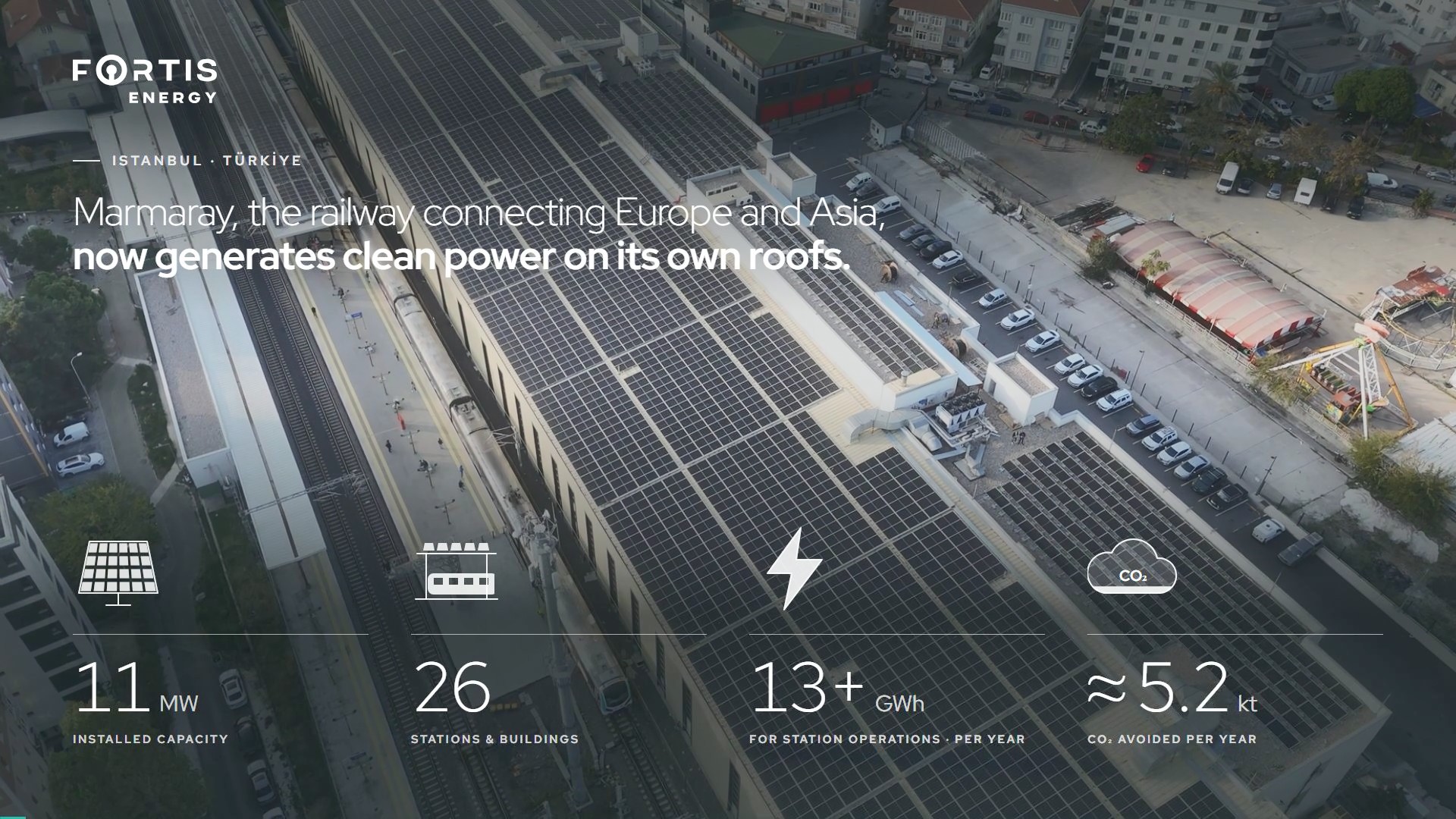 Fortis Energy has completed the rooftop solar project carried out on Marmaray, the 76-kilometre commuter rail line connecting the European and Asian sides of Istanbul through a tunnel beneath the Bosphorus. The project was delivered for Turkish State Railways (TCDD).
The works cover 11 MW of installed capacity across 26 sites: the platform canopies, station entrances and footbridges of 22 stations, together with four operational buildings, including administrative facilities and rolling-stock depots. Panel installation and the electrical and mechanical works have been completed at every site and the plants are ready to supply the stations' own operations.
Rather than a single central plant, capacity is spread along the line, with each installation feeding the station or building it sits on. Annual output is expected to exceed 13 GWh, equivalent to the consumption of roughly 4,600 households, and is projected to avoid approximately 5,700 tonnes of CO₂ per year. The electricity covers station and facility loads: lighting, ventilation, escalators and lifts, signalling and control, passenger information systems and depot operations. The power that moves the trains themselves comes from the line's separate overhead system and is unaffected.
The approach reflects how urban rail actually consumes electricity. Stations draw power continuously, and they draw most of it during daylight hours, when the panels generate; so the greater part of the output is used on site rather than exported to the grid. Building on roofs that already exist requires no additional land, reduces the volume of power taken from the grid and lowers long-term operating costs, while adding domestic renewable capacity in a country that imports most of its energy.
Delivery required one mounting and electrical design adapted to four different roof types, from curved platform canopies to large industrial depot roofs, across both continents and above a railway that remained in service throughout.
Marmaray occupies a distinct position within Istanbul's transport network, serving as a backbone for commuter mobility, suburban development and regional connectivity. Generating power on this infrastructure makes a public transport system part of the energy supply rather than only a consumer of it.
The same approach applies to surface rail networks in Türkiye and across Europe, where station and depot roofs remain a largely unused surface for renewable generation and a practical contribution to sustainable urban development.